The LiteLLM Auth Bypass Chain Ransomware Gangs Are Actually Using
A command injection bug that needed an API key stopped needing one the moment researchers chained it with a one-character Host header trick — and Qilin ransomware affiliates are already using the combo to drop cryptominers on AI gateways.
One malformed character in an HTTP Host header. That is the entire distance between “this vulnerability requires a valid API key” and “this vulnerability requires nothing at all.” Not a zero-day in some obscure parsing library, not a kernel race condition — a header value that a web framework trusted a little too much.
I run infrastructure for a living, and the thing that actually stopped me mid-scroll on this one wasn't the CVSS 10.0 score. Scores get inflated. What got me was how boring the underlying bug is once you strip away the AI branding. A command injection flaw in a test endpoint, and an authentication bypass caused by string concatenation. These are the kinds of bugs we were finding in enterprise web apps a decade ago. They just moved into a new neighborhood — the AI gateway sitting between your applications and every LLM provider you pay for — and the neighborhood hasn't finished building its fences yet.
This is the story of CVE-2026-42271 and CVE-2026-48710, how Horizon3.ai chained them into unauthenticated remote code execution against LiteLLM, and why Qilin ransomware affiliates are now treating AI gateways as just another initial-access target.
What LiteLLM Actually Is, and Why It's Everywhere
If you haven't touched it directly, LiteLLM is still worth knowing about, because there's a decent chance something in your org already does. It's an open-source proxy and SDK that sits in front of a hundred-plus different LLM providers — OpenAI, Anthropic, Azure, Bedrock, local models — and gives every downstream application a single, consistent API to call. Teams stand it up so they can swap model providers without rewriting application code, centralize API key management, enforce spend limits, and get one place to log every prompt and completion.
That centralizing role is exactly what makes it dangerous to get wrong. A LiteLLM gateway typically holds the API keys for every connected model provider, sees a meaningful slice of an organization's AI traffic, and runs as a service that's reachable from application servers across the network. Compromise the gateway and you don't just get one system — you get a pivot point and a wallet.
Bug One: CVE-2026-42271, Command Injection in an MCP Test Endpoint
LiteLLM supports the Model Context Protocol (MCP), which lets an LLM call out to external tools. To make configuring those tool servers easier, LiteLLM shipped two convenience endpoints for testing an MCP server connection before saving it:
POST /mcp-rest/test/connectionPOST /mcp-rest/test/tools/list
Both accept a full server configuration in the request body — including command, args, and env fields used by MCP's stdio transport. When you call either endpoint with a stdio-type config, LiteLLM spawns whatever command you supplied as a subprocess, directly on the proxy host, so it can test the connection. There's no allowlist on what that command can be. Supply a reverse shell one-liner instead of a legitimate MCP server binary, and the proxy runs it for you.
When this was originally disclosed on April 20, 2026, it was rated as requiring authentication, because reaching these endpoints meant presenting a valid LiteLLM proxy API key. That's a meaningful mitigating factor if the authentication check actually holds. It didn't.
Bug Two: CVE-2026-48710, “BadHost” in Starlette
Starlette is the lightweight ASGI framework underneath FastAPI, and by extension underneath a large chunk of the Python AI-infrastructure world — vLLM, LiteLLM, and plenty of homegrown MCP servers all sit on top of it. CVE-2026-48710, publicly disclosed on May 26, 2026 and nicknamed “BadHost,” is a Host-header validation bypass affecting every Starlette release from 0.8.3 through 1.0.0.
The root cause is almost insultingly simple. Starlette reconstructs the request URL by directly concatenating the raw Host header with the request path — f"{scheme}://{host_header}{path}" — without validating that the Host header is actually a well-formed hostname first. Feed it a single malformed character in the Host header, and you can desynchronize what the application thinks the request's origin and routing context are from what actually happens downstream. Any path-based or host-based security middleware built on top of request.url — including, as it turns out, authentication gating on specific routes — can be walked straight past.
The Chain: From “Needs a Key” to “Needs Nothing”
Individually, these are a medium-severity local-ish command injection and a header-parsing edge case. Horizon3.ai's researchers did the part that actually matters in vulnerability research: they asked whether the two combined into something worse. They did.
- Reconnaissance. Attacker identifies a network-reachable LiteLLM proxy whose Starlette dependency is pinned to
≤ 1.0.0— still the default for any deployment that hadn't explicitly bumped Starlette after the fix shipped. - Host header manipulation. Attacker sends a request to a protected route with a deliberately malformed
Hostheader, exploiting BadHost (CVE-2026-48710) to desynchronize Starlette's internal view of the request from the route's actual authentication expectations. - Authentication bypass. Because the API-key gate on the MCP test endpoints relied on that same flawed URL/host reconstruction, the bypass lets the request reach
/mcp-rest/test/connectionor/mcp-rest/test/tools/listwithout ever presenting a valid key. - Command injection. Attacker submits a stdio MCP server configuration where
commandis not a legitimate MCP binary but an arbitrary shell command — a reverse shell, a downloader, a miner dropper. - Execution. LiteLLM (
CVE-2026-42271) spawns that command as a subprocess on the proxy host, running as the LiteLLM service account, with no credentials ever having been supplied.
Horizon3 validated this end-to-end on June 1, 2026 and assessed the combined chain at CVSS 10.0. Once you're executing arbitrary commands as the proxy process, everything downstream falls out fairly naturally: the environment variables and config LiteLLM holds for every connected model provider, any secrets the proxy was trusted with, and a foothold from which to move laterally into whatever else is reachable from that host.
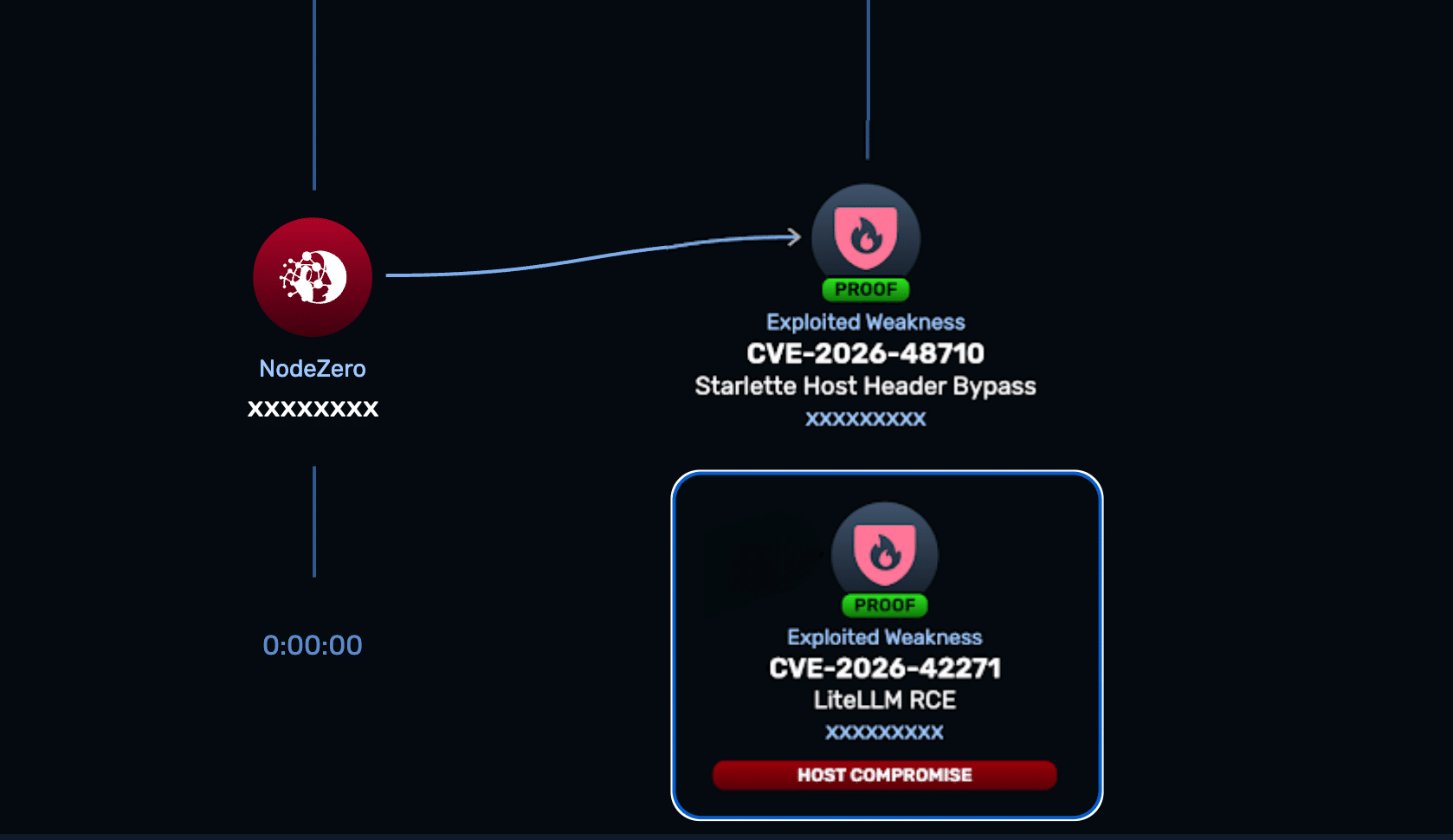
Figure: The attack path from a Starlette Host-header validation bypass to unauthenticated remote code execution in LiteLLM. (Source: Horizon3.ai)
Timeline
| Date | Event |
|---|---|
| April 20, 2026 | CVE-2026-42271 disclosed as an authenticated command injection flaw in LiteLLM's MCP test endpoints |
| May 8, 2026 | LiteLLM ships version 1.83.7, adding authorization controls and an updated Starlette dependency |
| May 26, 2026 | Public disclosure of CVE-2026-48710 (“BadHost”), the Starlette Host-header bypass |
| June 1, 2026 | Horizon3.ai validates the chained exploit path: unauthenticated RCE against affected LiteLLM deployments |
| June 8, 2026 | CISA adds CVE-2026-42271 to the Known Exploited Vulnerabilities catalog, citing confirmed in-the-wild exploitation and tying it to Qilin ransomware activity |
Who's Actually Exploiting This: Qilin's Crypto Side Hustle
The CISA KEV entry is where this stopped being theoretical. CISA's own listing ties active exploitation of CVE-2026-42271 to the Qilin ransomware group (also tracked as Agenda). What's notable is what Qilin-linked actors are doing with the access first: reporting indicates they're using the chain to drop an XMRig cryptominer, delivered as an ELF binary, and that the intrusions include host fingerprinting and killing off competing miner processes before installing their own — standard opportunistic cryptojacking hygiene.
That's not the same as Qilin dropping ransomware on every box it touches through this chain, and it's worth being precise about that distinction. But treating it as “just a coin miner” misses the point. A ransomware affiliate group getting unauthenticated code execution on an AI gateway is a reconnaissance and access-brokering opportunity as much as it is a mining opportunity. The gateway sees which internal systems call it, holds provider credentials that are worth stealing outright, and sits on a network segment that's presumably trusted enough to reach production model providers. Mining crypto on it today doesn't mean the same access doesn't get repurposed or resold for something more damaging tomorrow — that's exactly the initial-access-broker pattern ransomware ecosystems have run for years.
Indicators of Compromise
| Indicator | Type | Description |
|---|---|---|
| Unexpected subprocess execution | Behavioral | Commands spawned through LiteLLM MCP test endpoints |
Requests to /mcp-rest/test/connection | HTTP activity | Suspicious use of MCP testing functionality |
Requests to /mcp-rest/test/tools/list | HTTP activity | Potential exploitation attempt |
| Malformed or unusual Host header values | Network indicator | Potential abuse of the BadHost bypass |
| Unauthorized command execution / new outbound connections from the proxy host | Host activity | Evidence of successful exploitation |
Why This Is Bigger Than One Proxy Project
Starlette isn't a niche dependency. It's the ASGI layer under FastAPI, which is arguably the default choice for anyone standing up a Python API in 2026 — AI gateway, MCP server, internal tool, doesn't matter. BadHost affects every one of those deployments that hadn't pinned Starlette to 1.0.1 or later, regardless of whether LiteLLM is anywhere in the stack. LiteLLM just happened to be the deployment where a second bug turned a framework-level header-parsing quirk into full unauthenticated RCE with a documented ransomware group already using it.
That's the pattern I'd flag to anyone building on top of the current wave of AI infrastructure: the AI-specific parts of these stacks — the MCP tool-calling, the model routing, the prompt handling — get a lot of security scrutiny because they're new and unfamiliar. The boring parts underneath — the web framework, the auth middleware, the dependency pinning — get treated as solved problems because they're old. They aren't automatically solved just because they're old, and this chain is a clean demonstration of why: one classic command injection, one classic header-trust bug, neither one novel, both shipped in widely-deployed infrastructure that a lot of organizations stood up in the last eighteen months without the change-control rigor they'd apply to a database or an identity provider.
My Take
I've spent a good chunk of my career doing exactly the kind of work that would have caught this before it shipped: reviewing what gets exposed at the network edge, questioning why a “test connection” endpoint needs to spawn arbitrary subprocesses in the first place, and pushing back when a team wants to stand up new infrastructure faster than they can document what's actually reachable on it. That instinct is exactly what's missing from a lot of AI gateway rollouts I've seen described this year, including ones I've been asked to advise on informally. Teams are standing up LiteLLM, or something like it, over a weekend because a data science team needs multi-provider model access now, and the person doing the install is thinking about API routing, not about whether a debug endpoint should require anything more than “is this request theoretically authenticated.”
The specific bugs here are almost secondary to the pattern. A command injection in a “just for testing” endpoint is the kind of finding that shows up in code review checklists from fifteen years ago — any endpoint that constructs and executes a subprocess from user-supplied input should be treated as equivalent to remote code execution by design, not as a convenience feature that happens to be gated by auth. And an auth check that trusts framework-level URL reconstruction without validating the header that reconstruction depends on is a classic case of security logic living at the wrong layer. Put a WAF-grade assumption (“the Host header is trustworthy”) underneath an app-grade authorization decision, and you've built exactly this bug, just waiting for someone to notice the seam.
What actually worries me isn't LiteLLM specifically — it patched, the maintainers did the right thing shipping 1.83.7 with real authorization controls before either CVE was even public in combination. What worries me is the number of AI gateways out there that got stood up by teams without a security review gate in the deployment pipeline, running whatever version was current the day someone ran pip install litellm[proxy] and forgot about it. Qilin didn't need a novel technique here. They needed patch laziness at scale, and the current AI infrastructure boom is generating that at a rate we haven't seen since the early cloud land-grab.
What You Should Do Right Now
- Inventory every LiteLLM deployment you have. Not just the sanctioned one — check for shadow instances spun up by individual teams for a proof of concept that never got decommissioned. If you don't know it's running, you can't patch it.
- Upgrade LiteLLM to 1.83.7 or later, and Starlette to 1.0.1 or later, independently. Both matter. Patching LiteLLM alone without confirming the Starlette version in its dependency tree leaves BadHost in place if something re-pins an older Starlette release.
- Check your dependency lockfiles, not just the top-level package. Run
pip show starlette(or checkrequirements.txt/poetry.lock/uv.lock) inside the actual container image you're running in production — don't trust that a LiteLLM version bump automatically pulled a fixed Starlette. - If you can't patch immediately: block external access to
/mcp-rest/test/connectionand/mcp-rest/test/tools/listat the reverse proxy or WAF layer, and restrict the LiteLLM proxy to trusted network segments only — it should never need to be reachable from the open internet. - Rotate every credential the proxy held if you have any reason to believe you were running a vulnerable version while exposed — provider API keys, database credentials, anything in its environment variables. Assume they were readable, not just theoretically readable.
- Hunt your logs for the indicators above: requests to the MCP test endpoints, malformed or anomalous Host headers, unexpected subprocess spawns from the LiteLLM service account, and outbound connections to unfamiliar hosts (XMRig needs to phone home to a mining pool — that's a detectable, specific signal, not vague “unusual traffic”).
- Treat every “test” or “debug” endpoint in your AI infrastructure as a standing RCE risk until proven otherwise. If a route exists to let an admin test a configuration by executing something, ask who can reach that route, and whether “valid API key” is really the only thing standing between that and disaster — because in this case, it wasn't standing between anything at all.
This article was researched and drafted with AI assistance as part of an experiment in building a faster tech-writing workflow, then reviewed and edited before publishing.
Primary source: CVE-2026-42271: LiteLLM Unauthenticated RCE — Horizon3.ai, June 1, 2026 (updated August 1, 2026)
Secondary sources: LiteLLM Flaw CVE-2026-42271 Exploited in the Wild, Chains to Unauthenticated RCE — The Hacker News, June 2026; LiteLLM Vulnerability CVE-2026-42271: 7 Things to Know — CybelAngel; LiteLLM vulnerability under active attack, CISA warns — Help Net Security, June 9, 2026; CISA Adds Two Known Exploited Vulnerabilities to Catalog — CISA, June 8, 2026.