FalconFlank: A Race Condition in CrowdStrike Falcon's Own Remediation Grants SYSTEM
A TOCTOU race in CrowdStrike Falcon's Office macro remediation lets a local attacker hijack the sensor's own privileged cleanup routine for DLL side-loading straight to SYSTEM — no patch yet, only a policy workaround.
The proof-of-concept screenshot the researcher posted to GitHub is named Screenshot 2026-09-02 195701.png. Nothing dramatic about the filename — until you look at what it actually shows: a command prompt running as NT AUTHORITY\SYSTEM, spawned from inside CrowdStrike Falcon, the endpoint agent whose entire job on that machine is to stop exactly that from happening.
I've spent enough years running EDR fleets across mixed Windows estates to know the mental model everyone quietly relies on: the agent is trusted infrastructure, not attack surface. FalconFlank is a sharp reminder that the second half of that sentence was always going to catch up with us eventually.
What FalconFlank Actually Is
On September 3, 2026, a researcher operating under the handle Nightmare Eclipse — also known as Chaotic Eclipse, Infinite Nightmare, and MSNightmare — published a proof-of-concept privilege escalation exploit for CrowdStrike Falcon Sensor named FalconFlank, along with the code on GitHub. The bug abuses Falcon's own Office malicious macro remediation capability: a feature, enabled under Falcon's Phase 3 “Optimal Protection” policy tier, that automatically inspects Microsoft Office documents, detects suspicious macros, and strips or removes them on the endpoint's behalf.
That remediation action runs with the same elevated privilege the Falcon sensor itself holds — which on Windows means it runs as NT AUTHORITY\SYSTEM under the csfalconservice.exe process. According to public technical analysis of the PoC, the flaw is a classic time-of-check to time-of-use (TOCTOU) race condition: there's a window between the moment Falcon's remediation logic checks what it's about to act on and the moment it actually acts, and an attacker who already has local code execution can win that race, redirecting the privileged operation into DLL side-loading and ultimately a SYSTEM-level command shell.
In the researcher's own words, from the GitHub README:
“FalconFlank is a 0day privilege escalation that abuses the office malicious macros remediation in Crowdstrike Falcon Sensor, obviously by the time I drop this Crowdstrike would already have detections for it so if you want to test you either have to add it to the exclusions or obfuscate the PoC and change the dll load technique. As of now it works in a fully updated windows 11 25H2 / Windows Server 2025 with Crowdstrike Falcon — Phase 3 Optimal Protection + needs ‘Microsoft Office file malicious macro removal.’”
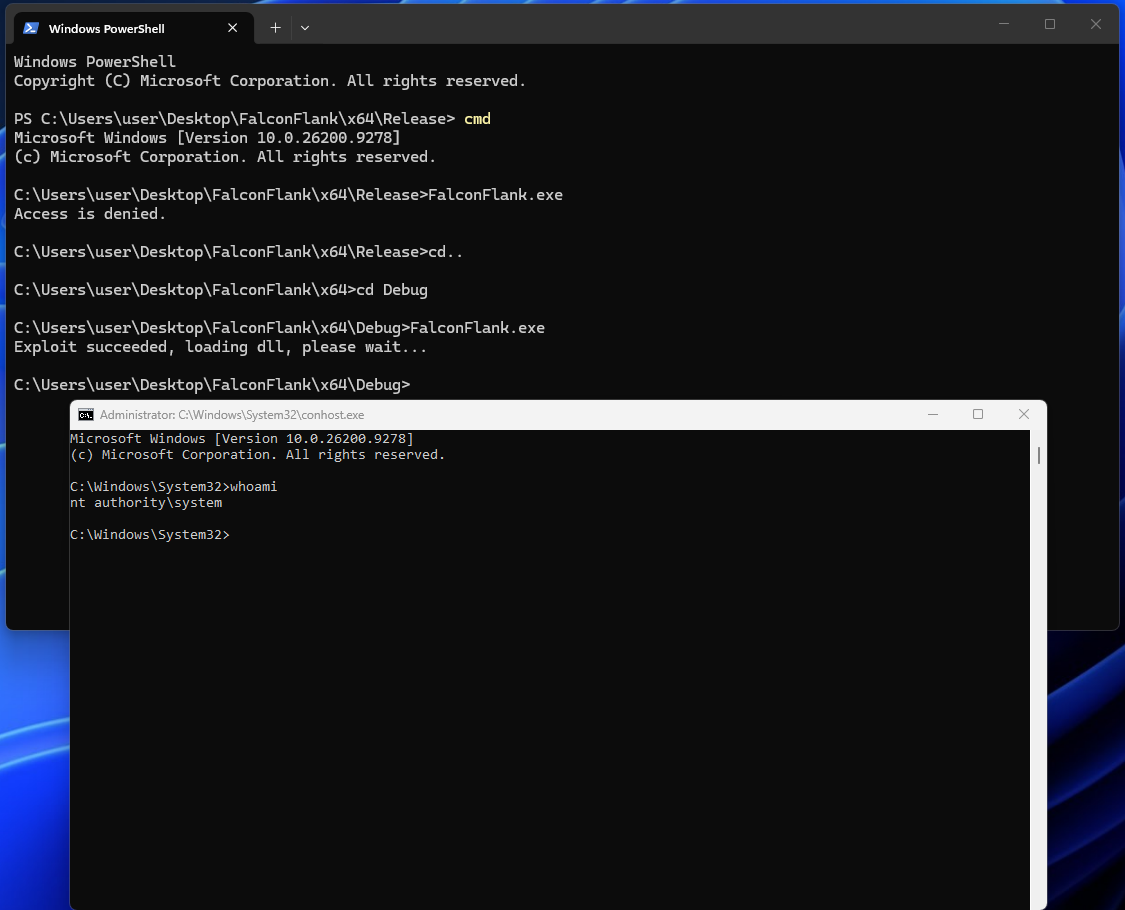
Figure 1: The FalconFlank proof-of-concept screenshot published to the exploit's GitHub repository, showing a SYSTEM-level command shell obtained through CrowdStrike Falcon's macro remediation routine (Source: MSNightmare/FalconFlank on GitHub).
There is, as of this writing, no CVE identifier and no CVSS score assigned to FalconFlank. CrowdStrike has not shipped a patch. The only sanctioned response is a policy-level workaround, delivered through a support-portal advisory that isn't publicly readable unless you're already a CrowdStrike customer with portal access.
FalconFlank at a Glance
| Detail | Status |
|---|---|
| CVE ID | None assigned |
| CVSS score | None published |
| Root cause | TOCTOU race in Office malicious macro remediation → DLL side-loading |
| Affected platform | CrowdStrike Falcon Sensor, Phase 3 “Optimal Protection” policy, with Suspicious Macro Removal enabled |
| Affected OS | Fully patched Windows 11 25H2, Windows Server 2025 |
| Privilege gained | NT AUTHORITY\SYSTEM |
| Patch available | No |
| Workaround | Disable the “Microsoft Office File Suspicious Macro Removal” Falcon policy setting |
| Disclosed | September 3, 2026, via public GitHub PoC (no coordinated disclosure to CrowdStrike beforehand) |
The Attack Chain: Turning a Cleanup Feature Into a SYSTEM Shell
Reconstructing the mechanics from what's been published (CrowdStrike's own technical write-up sits behind a support-portal login), the chain looks like this:
- Prerequisite: local code execution. This isn't a remote, unauthenticated bug. The attacker needs to already be running code on the target Windows 11 25H2 or Server 2025 machine — the classic starting point for any local privilege escalation, including a foothold from phishing, a low-privilege service account, or a compromised standard user session.
- Trigger the remediation workflow. The attacker places or opens an Office document containing a macro that Falcon's Suspicious Macro Removal feature flags as malicious. Because this feature is part of Falcon's automated protection, no further action is needed — the sensor's own remediation logic kicks in on its own.
- Falcon's privileged process checks the target. The remediation routine, running as SYSTEM via
csfalconservice.exe, checks the state of the file or path it's about to remediate. - The attacker wins the race. In the gap between that check and Falcon's follow-up action — the TOCTOU window — the attacker swaps what sits at that path, exploiting the fact that a low-privileged process can still manipulate filesystem state (reparse points and symlink tricks are the usual tool for this class of bug, and it's notable that Arctic Wolf's advisory specifically recommends restricting non-privileged users' ability to create NTFS symlinks as a mitigating control).
- DLL side-loading. Falcon's own privileged remediation action ends up writing or acting on attacker-controlled content in a location a trusted, high-privilege process will later load from.
- SYSTEM execution. That trusted process loads the planted DLL, and the attacker's code now runs as
NT AUTHORITY\SYSTEM— a full command prompt with SYSTEM privileges, per BleepingComputer's reporting.
The researcher was upfront that the public PoC is unreliable by design — race conditions are inherently timing-sensitive, and the code is deliberately rough so it doesn't hand attackers a turnkey weapon. But an unreliable PoC in public is still a roadmap. Weaponizing a known TOCTOU primitive against a documented target is a matter of engineering effort, not novel research.
This Wasn't an Isolated Bug — It Was One Bug in a Weekly Spree
FalconFlank didn't land in isolation. The same researcher published a run of privilege-escalation and crash PoCs against multiple security vendors in the same week, apparently deliberately timed to land in the gap after that month's Patch Tuesday.
| Exploit | Target | Impact | Status (as of writing) |
|---|---|---|---|
| FalconFlank | CrowdStrike Falcon Sensor | LPE to SYSTEM via macro remediation TOCTOU | No CVE, no patch — workaround only |
| HardBreacher | Kaspersky Endpoint Security for Windows (v14.0.0.504) | LPE; can also destabilize the AV's UI process and file-access controls | Resolved — Kaspersky shipped a fix via automatic/database update |
| PrettyPrague | Gen Digital / Avast Antivirus | LPE; dumps the SAM database via an Avast Sandbox flaw, spawns full SYSTEM shell | Patched for specific Avast Windows versions; Gen Digital says other products (AVG, Norton) may be affected |
| GreenSection | NVIDIA (Vulkan/OpenGL stack) | Denial of service — crashes any app using Vulkan or OpenGL | No fix confirmed publicly |
This same researcher has been dropping zero-days against Microsoft products since April 2026 — LegacyHive, RoguePlanet, BlueHammer, RedSun, YellowKey, GreenPlasma, MiniPlasma, and UnDefend. Some of those have since been patched; others, including RedSun and UnDefend, are reportedly still unfixed. Microsoft's own response to the earlier disclosures was a public warning about legal action against “malicious activity causing real harm to our customers” — language many in the security community read as a threat aimed at the researcher rather than a serious plan to prosecute active attackers.
Security researcher Kevin Beaumont independently verified that FalconFlank and the other PoCs released that week actually work. Asked by The Register why the researcher was branching out from Microsoft to other security vendors, Beaumont didn't mince words:
“Kinda makes sense they'd branch out to other vendors as there's problems across the endpoint security space with the quality of the security products in terms of…security unfortunately. Hopefully it causes cybersecurity vendors to up their game, stop hyping hypothetical AI attacks, and instead make their own products secure for customers.”
That line is worth sitting with. It's not a researcher's grudge talking — it's a widely respected, independent voice in the field confirming that this is a pattern, not a one-off.
CrowdStrike's Response — and Its Limits
When BleepingComputer, The Hacker News, and The Register all asked CrowdStrike for details, they got the same statement:
“We are actively investigating these claims and advise customers to disable the Microsoft Office File Suspicious Macro Removal Windows policy setting. Customers remain protected through the Cloud Anti-malware for Microsoft Office Files settings. We refer customers to the FalconFlank Tech Alert in the CrowdStrike support portal.”
Two things stand out about that response. First, the workaround is a straightforward trade: turn off the vulnerable remediation feature and lean on CrowdStrike's Cloud Anti-malware scanning for Office files instead. That's a reasonable interim posture, but it's a real reduction in defense-in-depth for organizations that specifically enabled Suspicious Macro Removal as a layered control — not a like-for-like replacement.
Second, the technical advisory itself sits behind CrowdStrike's customer support portal. If you don't have an active support contract and login, you can't read your own vendor's account of a vulnerability affecting your endpoints unless you follow the trail through security journalists and third-party write-ups, which is exactly what this article and the sources it cites had to do. For a vulnerability with this level of privilege impact, that's a disclosure posture worth pushing back on.
My Take
I did my MSc dissertation research around threat modeling for privileged agents on managed endpoints, and the uncomfortable conclusion I kept coming back to then still holds: any piece of software that runs with SYSTEM privileges and performs automated actions on attacker-influenceable input is, definitionally, a privilege escalation surface. EDR agents are the single largest concentration of that risk on a modern Windows estate, because they're the one thing every security team is contractually obligated to trust unconditionally and rarely audits with the same rigor they'd apply to, say, a custom internal service running as SYSTEM.
What makes FalconFlank interesting to me isn't the specific TOCTOU bug — race conditions in check-then-act file operations are a well-understood, decades-old bug class, and CrowdStrike is very much not the first vendor to trip over one. What's interesting is where it sits: inside a remediation feature. Remediation code paths are built to run automatically, without human confirmation, with elevated rights, against input a low-privileged process just handed the system (a document, in this case). That's precisely the profile of code that most deserves hostile-input scrutiny and gets, in practice, the least of it, because it's framed internally as “our own cleanup logic,” not attacker-facing surface.
I'd also push back gently on the framing that this is purely a CrowdStrike problem. HardBreacher, PrettyPrague, and the string of Microsoft zero-days from the same researcher say this is an industry-wide pattern in how security vendors build automated response actions, not a CrowdStrike-specific engineering failure. If anything, CrowdStrike's public response here — acknowledging the report and shipping a workaround within days — compares reasonably well to Microsoft's earlier instinct to threaten legal action against the researcher instead of triaging faster.
None of that changes the operational reality for anyone running Falcon on Windows 11 or Server 2025 today: there is a working, publicly documented path from local code execution to SYSTEM, no patch exists, and the vendor's own advisory isn't even publicly readable.
What You Should Do Right Now
- Apply CrowdStrike's workaround immediately. Disable the “Microsoft Office File Suspicious Macro Removal” policy setting in the Falcon console for any Windows 11 25H2 or Server 2025 host group running Phase 3 “Optimal Protection.” Confirm propagation across every policy group, not just your default one — test/dev host groups get missed in exactly this kind of sweep.
- Compensate for the gap you just opened. Turning off Falcon's macro remediation removes a layer, so backfill it: enforce Group Policy to block macros originating from the internet, and set
VBAWarningsto disable all macros with notification. Don't rely on Falcon's Cloud Anti-malware setting alone as your only remaining control. - Restrict who can create NTFS symbolic links. Arctic Wolf's advisory calls this out specifically as a compensating control for the underlying race condition class — and it's cheap to apply broadly regardless of this specific bug.
- Tune detection for the specific artifacts, not just hashes. Hash-based signatures won't catch a re-obfuscated exploit. Watch for unusual SYSTEM-level child processes spawned by
csfalconservice.exe, unexpected DLL loads from non-standard paths around Office document handling, and any presence of a binary namedFalconFlank.exeor similar on endpoints. - Get your own copy of the tech alert. If your organization has a CrowdStrike support contract, pull the FalconFlank Tech Alert from the support portal directly rather than relying on secondhand summaries — including this one. Push your CrowdStrike account team for a concrete patch timeline in writing.
- Don't treat this as CrowdStrike-specific and stop there. If you also run Kaspersky, Avast/Gen Digital products, or NVIDIA drivers in the estate, check patch status on HardBreacher, PrettyPrague, and GreenSection while you're already in remediation mode — they surfaced from the same researcher in the same week.
- Re-open the review after the fix ships. Once CrowdStrike issues a real patch, re-enable Suspicious Macro Removal and validate it against the layered defaults you had before — don't leave the workaround in place indefinitely out of inertia.
This article was researched and drafted with AI assistance as part of an experiment in building a faster tech-writing workflow, then reviewed and edited before publishing.
Primary source: New CrowdStrike 'FalconFlank' zero-day grants SYSTEM privileges — BleepingComputer, September 4, 2026
Secondary sources: Researcher Releases FalconFlank PoC Showing Privilege Escalation in CrowdStrike Falcon — The Hacker News, September 2026; Prolific Microsoft 0-day hunter drops CrowdStrike Falcon exploit PoC — The Register, September 3, 2026; Chaotic Eclipse Releases Crowdstrike Falcon ZeroDay FalconFlank — Security Affairs, September 2026; CrowdStrike Falcon Sensor Local Privilege Escalation Zero-Day (FalconFlank) — Arctic Wolf, September 2026; FalconFlank proof-of-concept — GitHub (MSNightmare)